Thursday, 24 November 2011

Know when to walk away; know when to run

This started out as a reply to a comment on the LinkedPHPers group on LinkedIn; once I started writing, of course, it quickly grew beyond what was appropriate as a conversationally-inline comment. So I brought it over here. It's something I've been thinking about for a couple of weeks now, so let me get this anvil off my chest.


To R Matthew Songer1: I'd advise adding Ruby on Rails to that list of alternatives. I've been writing PHP for fun and profit since PHP 4 was still a future hope wrapped in hyperbole. Now that we've finally got a (mostly-)decent language in 5.3 for some serious software development, I'm burning out. Part of that burnout is due to what I see in the PHP community, part to geography, and part to other factors that approach "fit for use".

I've recently taken a post as Chief Engineer at a little startup nobody's heard of yet. Our prototype was done in PHP; it got the idea across well enough for our initial investors and customers to bang on our door. So the CEO and I thought, great, we'll find another senior2 PHP guy, write a real app (the prototype doesn't even have testable seams), and we're off.

If I were looking to hire a battalion of deputy junior assistant coders whose main qualification as PHP devs was being able to spell it whilst taking endless trips down the waterfall, I could do that. I was aiming higher: I wanted someone who knew his way around current best practices; who realises that being experienced is no excuse to stop learning aggressively; who understands how to build web apps that can evolve and scale; who looks for the best feasible way to do something instead of just the first one that pops into mind. I especially needed to find someone who was as BDD/TDD-infected as I am, and recognised the value of building tools and automation early (but incrementally) so that we'd be a lean, agile development machine when the rubber really needed to hit the road, a (very) few short weeks from now.

In the States, or in much of Europe, or basically anyplace outside Singapore, I'd probably have a decent chance of finding such a person. Here, not so much. I was especially concerned by the way PHP usage seems to be devolving in these parts. There are lots of folks who think that it's a good idea to reinvent Every. Single. Wheel. themselves, without really knowing all that much about what has gone before. Frameworks are a good example; if you aren't intensely aware of how good software, sites and Web apps get built; if you don't even bother with encapsulation or MVC or SOLID or on and on, how can you expect anybody who does know his Craft from a hole in the ground to take you or your "tool" seriously? It might wow the management rubes who proudly admit they don't know squat — but in the world as it is, or at least as it's going to exist in the very near future, those will (continue to) be a vanishing breed even here. Even in a Second World Potemkin village of a city-state where what you are and who you know is far more important in most situations than what you've done and what you know, you're still running a risk that somebody is going to come along who actually gets up in the morning and applies herself or himself to writing better stuff than they wrote yesterday. And, eventually, they're going to wipe the floor with you — either you as an individual or you as a society that remains stubbornly top-down-at-any-cost.3

In contrast, my experience talking with Ruby and Rails people here, even people with absolute minimal experience in Rails, is chalk-and-Friday different. For one illustrative example: one book that more than half the yes-I've-done-a-bit-of-Rails folk I've talked to here is Russ Olsen's Eloquent Ruby (ISBN 978-0-321-58410-6). Your average PHP dev — or C++ dev or Java dev — is fighting the dragons (schedule, complexity, communication, etc.) far too much to get out of fire-drill-coding mode and into writing. If you believe, as I do, that all truly competent software is written as a basis for and means of conversation between humans, and incidentally to be executed by a computer, then you know what I'm driving at here. Knuth's dictum that programming is a creative, literary act is too easily lost when you're just throwing yourself against the wall every day trying to see which of you will break first. (It's very rarely the wall.)

If you write software that can be read and understood, and intelligently expanded on or borrowed from, and your whole view of the omniverse changes. Your stress goes down, your written works' quality goes up, and you enjoy what you do a lot more. Automating away the repeated, detailed work and having a sensible process so you don't give yourself enough rope to shoot yourself in the foot regularly (with apologies to Alan Holub) is the most reliable way yet found to get your project schedule under your control instead of vice versa.

All this does however have one pre-supposition, which I have received numerous complaints on here locally: you and your team must be fully literate and fluent in a shared human language4. The vast majority of software to date seems to be associated with four such: Business Standard English, Russian, Japanese and Chinese. If your team shares a different language at a (near-)native level, with one or more of you having similar skills in the earlier four, you should be able to make do for yourself rather nicely. Having others build on your work, if desired, is going to be a bit more problematic. Poor communication has been at least a strong contributing cause, if not the root cause, of every failed project I have seen in my career. If you can't speak the customer's language effectively enough, with nuance, subtlety and clarity as needed, then your chances of project success are somewhat worse than my chances of winning the next six consecutive Toto jackpots — and I don't plan on buying any tickets.

Footnotes:

1. "I am sitting here tossing the options around for a business application, browser based, and trying to decide...PHP, Java, Python, .NET?" (Return)

2. Why insist on a senior guy when they're so rare here (at least the PHP variety)? Because I figure that with a senior dev coming on a month from now, we'd spend roughly half the time between now and our first drop-deadline writing magnificent code, and the other half building infrastructure and process to make building, testing and deploying the magnificent code we write straightforward enough not to distract the team from the creative acts of development. There's not enough time to wipe anybody's backside. (Return)

3. The phrase "at any cost" always reminds me of a company I contracted to back in the late '80s. My boss there had a (large) sign above his desk, "We will pay any price to cut costs." The company eventually paid the ultimate price — bankruptcy. (Return)

4. I'm describing what used to be called "college- or university-level language skills", but as any university teach will readily tell you, the skills exhibited by students have dropped precipitously and measurably in the last three decades or so. (Return)

Thursday, 10 November 2011

ANFSD: GnuPG Semi-Pro Tip

After you use GNU Privacy Guard, or really any public-key encryption system, for a while, you'll probably have it set up for more than one of your email addresses. It's tempting to have the same pass-phrase for all your IDs.

Don't.

For instance, I use long-ish pass-phrases that are similar enough to remember easily but different enough that a dictionary attack is highly unlikely to be successful. That also protects me from doing something silly/confusing/potentially dangerous like thinking I'm sending from one email address when my email package actually defaults to another. Since the pass-phrases differ, you can't sign a message sent with Account B with the phrase from Account A (that you thought you were using but you were in too much of a hurry to pay attention to the 'From' line).

DRY May Not Be Wet, But It Sure Is Cool

As any developer who values his time, sanity, or amicable relations with teammates who have to maintain his code knows, one of the cardinal rules of modern programming is "Don't Repeat Yourself", or DRY. This is obviously something that should make reading code easier. Obviously, therefore, it should be applied except where the lengths you go to to not repeat yourself make your code harder for someone else to read. The idioms of some languages help this more than those of others.

I was recently browsing through a (rather poor) Ruby programming book when this hit me between the eyes. Consider this ERB example from the book.

Pretty ugly, yes? Part of that ugliness is intrinsic to ERB; which is why people are leaving it in droves.

Compare this exact translation into Haml:

= form_for @product do |f|
  - if @product.errors.any?
    .error_explanation
      %h2= "#{pluralize(@product.errors.count, "error")} prohibited this product from being saved:"

      %ul
        - @product.errors.full_messages.each do |msg|
          %li= msg

  .field
    = f.label :title
    %br/
    = f.text_field :title

  .field
    = f.label :description
    %br/
    = f.text_area :description

  .field
    = f.label :image_url
    %br/
    = f.text_field :image_url

  .field
    = f.label :price
    %br/
    = f.text_field :price

  .actions
    = f.submit

A bit easier to understand, now that we've gotten most of the clutter out of the way, yes? Now, the repeating field definitions stick out like a sore thumb; they're almost the same, but not exactly. We've got three text_fields and one text_area, so a simple loop that just plugs in values won't quite cut it, will it? How about this:

= form_for @product do |f|
  - if @product.errors.any?
    .error_explanation
      %h2= "#{pluralize(@product.errors.count, "error")} prohibited this product from being saved:"

      %ul
        - @product.errors.full_messages.each do |msg|
          %li= msg

  - [:title, :description, :image_url, :price] do |name|
    .field
      = eval("f.label :#{name}")
      %br/
      = eval("f.text_field :#{name}") unless name == :description
      = eval("f.text_area  :#{name}") if     name == :description

  .actions
    = f.submit

If you're coming to Ruby from a PHP background, you've been conditioned not to use eval; there's all sorts of nastiness that could lurk there, especially when code is sloppy. (And PHP code is notorious for its sloppiness.) But in Ruby and Haml, this lets us solve a problem more eloquently than the two or three other possibilities that come to mind. Further, the idiom of the repeated-but-not-repeated text_field/text_area fragment

      = eval("f.text_field :#{name}") unless name == :description
      = eval("f.text_area  :#{name}") if     name == :description
should make it clear to even the most hurried reader that we're dealing with a special case. This is one of those situations where a helper method would be nuclear overkill. (If we were scattering dozens of these all-but-one-fields-is-the-same forms through an app, I'd revisit that stance.)


OK, but why blog about this in the first place? Well, the company I'm working with now is looking for a senior Ruby/Rails dev. Most of the CVs we're getting are from mid-level guys (if you're a Rails doyenne (i.e., female), please email!) who have done some Ruby and one or two other languages, generally PHP and Java. What I've learned, on both sides of the table, is that if you've got some experience in several languages that aren't all closely-related to each other, it's a lot easier for you to ramp up on any language you need. Any language will eventually go out of favour. Being able to code idiomatically in anything you need to, won't.

Tuesday, 8 November 2011

Eloquence Is "Obsolete". We're Hurting. That's Redundant.

Code is meant to be read, understood, maintained and reused by humans, and incidentally to be executed by a computer. Doing the second correctly is far, far less difficult than doing the first well. Innovation is utterly meaningless without effective communication, and that is at least as true within a team as between it and a larger organisation, or between a company and its (current and potential) customers.

The degree to which a class framework, or any other tool, helps make communication more effective with less effort and error should be the main determinant of its success. It isn't, for at least two reasons. One, of course, is marketing; we as a society have been conditioned not to contest the assertion that the better-marketed product is in fact superior. In so doing, we abdicate a large degree of our affirmative participation in the evolution of, and the control over society at the small (team/company), mid-level (industry) and wider levels. We, as individuals or organisations, devolve from customers (participants in a conversation, known as a 'market', in which we have choices) into consumers (gullets whose purpose is to gulp endless products and crap cash).

More worrying is that effective, literate communication has gone completely out of fashion. Whether or not you blame that on the systematic laying waste of the educational system over the last thirty years, it's increasingly nonsensical to argue with the effect. People are less able to build understanding and consensus because they do not have the language skills to communicate effectively, and have been conditioned not to view that as a critical problem urgently requiring remediation. Oh, you'll hear politicians bloviating about how "the workforce needs to improve" or "education most be 'reformed' for the new era", but that's too often a device used to mollify public opinion, make it appear as though the politicians are Doing Something effective, and especially to preempt any truly effective public discussion leading to consensus that might effect real socioeconomic improvement rather than the "Hope and Change"™ genuine imitation snake oil that's been peddled for far too long.

Back on the subject of developers and tools, I would thus argue that what tools you use are a secondary concern; if you don't understand code that's been written, by others or (especially) by you, then a) that code can't be trusted to do anything in particular because b) someone didn't do their job.

Your job, as a developer, is to communicate your intent and understanding of the solution to a specifically-defined problem in such a way that the solution, and the problem, can be readily undestood, used, and built upon by any competent, literate individual or team following you. (Again, explicitly including yourself; how many times have you picked up code from a year or a decade before, that you have some degree of pride in, only to be horrified at how opaque, convoluted or incomprehensible it is?) Some computer languages make that effective communication easier and more reliable than others; some choose to limit their broad generality to focus on addressing a narrower range of applications more effectively and expressively.

That has, of course, now progressed to the logical extreme of domain-specific languages. General-purpose languages such as C, Ruby or Python try to be everything but the kitchen sink, and too often succeed; this makes accomplishing any specific task effectively and eloquently incrementally more difficult. DSLs are definitions of how a particular type of problem (or even an individual problem, singular) can be conceptualised and implemented; a program written in a proper DSL should concisely, eloquently and provably solve the problem for which it was written. This has sparked something of a continuing revolution in the craft and industry of software development; general-purpose languages arose, in part, because writing languages that are both precise enough to be understood by computers and expressive enough to be used by humans is hard; it still is. DSLs take advantage of the greatly-evolved capabilities of tools which exist to create other tools, compared with their predecessors of just a few years ago.

But the language you use to develop a program is completely irrelevant if you can't communicate with other people about your program and the ecosystem surrounding and supporting it. If half the industry reads and writes on a fifth-grade level, then we're literally unable to improve as we should.

To paraphrase the television-show title, it doesn't matter if we're smarter than a fifth-grader if that's the level at which we communicate. Improving that requires urgent, sustained and concerted attention — not only to make us better software developers, but to make the larger world in which we live a better place. Let's start by at least being able to communicate and discuss what "better" means. That in itself would be an epochal improvement, saving entire societies from becoming obsolete.

Sunday, 30 October 2011

Once more into the breach, dear colleagues, once more…

…or How I Learned to Stop Worrying and Love Serving Aboard Kobayashi Maru; a history lesson.

Once again, I've had an interesting couple of months. Between modern Singapore's regular effect on my health, some insane work and the opportunity to get even more insane work if my two best references weren't indefinitely unavailable (but hey, Thailand is usually lovely this time of year…or anytime, actually).

Ahem.

I am rediscovering a love for developing in Ruby after losing touch with it some ten years ago. In the Ruby 1.5 days, things like class variables and the hook system were either new and shiny, or had finally been thrashed into something both usable and beautiful. If programming was what you did to earn a living, then programming in Ruby was something that you thanked $DEITY for every day because, after all, how many people in this world get to use beautiful tools that make you measurably better at your craft while blowing your mind on a regular basis, and get paid for the privilege?

The Fall

Then Ruby on Rails came along, with the clueless-business-media hype and cult of personality built around G-d Himself, or at least the three-initial version of same as anointed by said media, and Things Changed:

New acquaintance: So what do you do for a living?

Me: I write computer software, mostly using Ruby, or when I have to, Delphi or C++.

N.A.: Oh, you're a Ruby on Rails programmer.

So I left Ruby behind. Delphi lasted for a while, until its competitor's lock on the default system combined with some spectacularly bad corporate timing to relegate it to an "oh yeah, I heard of that once" niche. And then came this gawky new kid called PHP.

PHP wasn't exactly "new" when I first got into it; version 3.x had been out for some time, and the in-beta version 4 had class-based object-oriented programming. It was more primitive than an 1898 Duryea automobile to a Porsche driver, but you could see that the basic principles were at least in sight. And so, as the dot-com bubble was starting to really inflate, I jumped into PHP with a vengeance. It wasn't a product of one of the existing tech-industry corporate titans and it wasn't tied to a single operating system or Web server (though it did seem to work best with the then-early Linux OS and Apache server).

The great thing about PHP is that just about anybody can poke at it for a while, and at the end have something that (seems to) work. The pathologically execrable thing about PHP is that the barrier to entry is microscopically low, lower even than for Visual Basic 6 back in the day. And so, the inevitable result was (and is) that you have literally hundreds of thousands, if not millions, who get jobs by saying "Yeah, I know PHP; I've done (this little site) and (that steaming mess with a lot of Flashy bling on it)." In reality, there are thousands, at most, of good PHP developers out there, with a few more thousands actively working at improving their craft.

Purgatory

So PHP 4 had a crappy object model that anybody could poke at or ignore at will. PHP 5, from mid-2004, started to get its head on straight with respect to both OOP and what it really took to do PHP well, but lots of damage had already been done. Innumerable client projects had either failed or become incredible maintenance/performance nightmares due to the shoddy code that PHP, and the community that grew up around it, encouraged mediocre/inexperienced/inattentive developers to write.

And then, in mid-2009, PHP 5.3 came into the world, and it was a glorious golden statue with legs of brown, wet mud. Many of us who wanted to see PHP evolve into a "properly" object-oriented language, along the path that it had been following, found much to rejoice in. Support for closures. Better internationalisation support. Far better garbage collection. A rearrangement and winnowing of the extension and application repository system that was the closest thing PHP has to Python's eggs or Ruby's gems.

PHP 5.3 also introduced what had to have been the most-requested new feature for years: namespaces. Namespaces are one solution to the problem of allowing the development team to organise collections and hierarchies of classes to both make them easier to work with conceptually, and of mitigating possible naming conflicts (class Foo in namespace Bar is "obviously" distinct from class Foo in namespace Barney.)

However, this is also where the legs of the "golden statue" were transformed into wet mud: the way in which the PHP namespace features work is so semantically and visually jarring, with so many inconsistencies visible to both the experienced pre-5.3 PHP developer and the experienced developer of object-oriented software in other languages, that it quickly became a laughingstock and a millstone. A necessary millstone, but one of which many writers of both code and prose waxed eloquent in their righteous, intricately-justified derision.

A New Hope

And this eventually served as a wake-up call to a number of those who view PHP as just another tool in their toolkit, as opposed to either a cash cow to be milked or a semi-religious icon to be polished and cared for in the precise fashion that the High Priests of Zend decree, or, those who simply never learned enough to care. Seven to ten years is a long time to spend in any one language for an experienced developer, and quite a number of highly-visible PHP community stalwarts have been publicly participating in and contributing to other communities: various JVM languages like Groovy, Scala and Clojure; Objective-C; C#; and Ruby.

A few short months ago, I had urgent need to re-immerse myself in Ruby, learn modern Rails, and make myself ready in all respects to participate in Ruby on Rails projects at a senior or leading level. This gave rise to a series of fortunate events, to paraphrase Lemony Snicket. I discovered that Ruby 1.9 is now a very advanced, mature language with solid experience-based best practices that are sensible and self-consistent. I discovered that Rails 3.1 is an incredibly productive way to get a Web site or application up and running, and that the ways in which it encourages you to code and think do not have the same propensity to inflict mortal wounds as, say, the overly-trusting PHP journeyman developer. Rails itself has grown to be a much larger community that no longer revolves around a single individual, or even a small group of individuals, as that it did seven years ago or as too many other languages do now. And, importantly, many of the things that make Rails great would not be practical, or even possible, were it built on and in any other language than Ruby

Above all, Ruby gives hope to those few, mindful of Knuth's saying that "programming is a literary act", understand that computer programs are written to be read and modified by humans, with computer execution almost a secondary concern over the life of a project. If you care about thinking creatively, if you enjoy having your mind regularly blown in ways that challenge you to actively and continuously improve your mastery of the craft of software development, you are going to love Ruby, and Rails.

An Evangelist Repurposed

And so, to any who are pondering a new Web project, who see how overwhelming the mindshare of PHP is and how obviously negligent (even to non-technical eyes) is far too much PHP code and, by extension, those who made such code available, I would ask you to strongly consider Ruby, and Rails, even if your team has little or no experience in them.

After all, quality and intelligence should, in any world worth living in, be major competitive advantages — or, rather, by rights, their lack must needs be mortal.

Monday, 3 October 2011

Drafting a Classic

By the way, count me among those who find the new Blogger in Draft interface to be a huge improvement over the old interface. The composing interface is clean and functional, with few distractions to typing away. It has the bonus of peripheral features and actions being visible at the periphery, ready when you need them but not with a busy interface distracting you away from the cursor. Previews open in a new tab (depending on your browser), with formatting applied properly (a huge improvement over the original). All in all, I really don't expect to have any problems of the scale of, say, the formatting catastrophe which I blogged about earlier.

The post settings such as keywords (called 'labels' here; many people know them as 'tags') are nicely done, with clean, usable interfaces that show exactly what's available and what you've done before you hit that big orange Publish button.

Nicely done, folks!

Saturday, 3 September 2011

Stock components: Nothing can go wrong…go wrong…go wrong…«boom!»

(Yes, Westworld had a view of modern software that's not so far off the mark, considering it was made in 1973.)

I use Macs for development, using both the native Unix OS and one or more VMWare Fusion VMs of Linux, BSD Unix or Windows, depending on the need. Even when I'm going to be deploying on a Linux or Unix server, I prefer to do my basic work using OS X native tools1.

Usually, all that rather famously Just Works. Sometimes, however, it provides lessons in the raving optimism that is Murphy's Law.

The remainder of this post is a summary of Wiki notes I made in chasing down one such occurrence.


This affects only the iMac, not the MacBook Pro2.

The Problem

PHP 5.3.4 as bundled with OS X does not work from Apache 2.2.14, also as bundled with OS X. This appears to have broken with the 10.6.7 update, as noted by many people, and was not fixed by updating to 10.6.8.

Pink Herring

(Not quite a red herring, mind you; just very close to one.)

One of the first things I thought of was to check what modifications had been made to php.ini over the course of time. Every time a new update to the PHP engine was installed as part of Apple's Software Update, the previous contents of the file were saved under a (nominally) intuitive name.

As of Saturday 3 September 2011, the iMac's /etc/ directory contained the following variants of php.ini:

-rw-r--r--  1 peerless  wheel  68920 Sep  3 12:37 php.ini
-rw-r--r--  1 peerless  wheel  45816 Oct 12  2009 php.ini-5.2-previous
-rw-r--r--  1 peerless  wheel  68920 Aug 13 19:11 php.ini.applesaved
-r--r--r--  1 peerless  wheel  69060 Dec 16  2010 php.ini.default
-r--r--r--  1 peerless  wheel  45104 Aug 25  2009 php.ini.default-5.2-previous

At this point, of course, I'm starting to say "uh-oh; a five-way diff?" Silly me; there's an easier way to deal with differences3. We'll get to that at another time; regardless of its usefulness in the current situation, it would be good information to have.

Inspiration

Then I thought, "hang on, have I checked the Apache logs?" Err... not yet. So, I opened a new browser tab and attempted to open http://localhost/~peerless/index1.php, which visibly failed; no output was rendered by the browser.

First off, check /var/log/apache2/access_log. Therein lies the first clue:

127.0.0.1 - - [03/Sep/2011:15:44:41 +0800] "GET /~peerless/index1.php HTTP/1.1" 200 20 "-" "Mozilla/5.0 (Macintosh; Intel Mac OS X 10_6_8) AppleWebKit/535.1 (KHTML, like Gecko) Chrome/14.0.835.126 Safari/535.1"

The 200 code means that the file was successfully sent, but it's a lot longer than 20 bytes. Clearly, something fell over and couldn't get up.

Looking at /var/log/apache2/error_log yields the crucial bit.

[Sat Sep 03 15:44:41 2011] [error] [client 127.0.0.1] PHP Fatal error:  Unknown: apc_fcntl_unlock failed: in Unknown on line 0

A quick bit of google-fu established that the APC PECL extension to PHP has a known bug in it (which is fixed in a release that should ship Any Day Now). I have three options available for action:

  1. Wait for the patch to be rolled up into a new release version, and upgrade my installed copy of APC;
  2. Pull the source for APC, make the change myself, and hand-build the extension; or
  3. Get rid of APC entirely, since this is strictly a dev machine that (for now) doesn't need to worry about caching at all.

A few seconds after implementing option 3, refreshing the index1.php page in the browser caused it to display as expected.

PHP is up again! Great rejoicing was heard through all the land! (Well, at least the room.)

Future Action

Moral of the story: At some point in the not-too-distant future, I Really Should go through the installed PEAR and PECL extensions and get rid of any I'm not actively using. That's what VMs are for: letting me try out various configurations as needed, without stepping on the main system. Oops.4.

Additionally, we still haven't answered the question: why are there five different versions of php.ini?

Footnotes:

1. Alternatively, for non-Windows OSs, I can use sshfs with MacFUSE to mount the VMs "hard disk" as part of the OS X file system. With Windows I go the other way; have VMWare share a directory on the host Mac with the Windows instance. (Return)

2. This turned out to be because APC was never installed on the MBP. But we'll get to that. (Return)

3. One easy way(for a competent dev, at least): whip up a VCS repository and add each file in turn, by date, as php.ini. Then use the VCS' diff tool to generate patches from each to the next. (Return)

4. And writing this page took several times as long as actually solving the problem. (Return)

Thursday, 18 August 2011

The Yak Shavery; J. Dickey, Proprietor

Starting a new project for a new client, coming up to speed on a bit of kit almost like something I poked around with a ways back, and a ferociously Singaporean flu do not make for a productive week. I'm almost back to where I expected to be by noon on Monday. Since it's noon on Thursday

What I'm trying to learn and leverage is Chef, an automated-configuration tool for computer systems (mostly servers). If you want to be able to reliably, repeatably set up a server (or a server farm), Chef or one of several available alternatives, will make your life much easier. Once you get your tool of choice working, that is.

Step One is, as various Chef amateur tutorials suggest, to start out with a plain-vanilla installation of your OS (Linux, in this case) of choice. Rather obviously, getting from bare metal (or bare VM disk platters, if you'd rather) to the basic working system should be push-button automatic as well. "Fine," you say, "nearly every major distro has its own automation system; surely I should be able to just pick up, say, a Red Hat Enterprise Linux clone like CentOS or Scientific Linux and use a Kickstart file, and it should Just Work. Right?"

Close; but then, "close" only counts for scoring purposes in horseshoes and (arguably) the use of hand grenades. This is neither, though it does have the ability to blow up in our faces with unpleasant consequences.

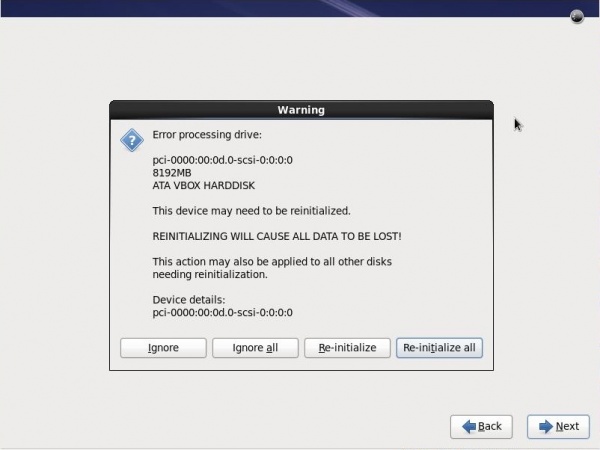
Putting together a basic Kickstart file to set up a base system (on which we can use Chef to complete installation and configuration; the whole point, remember) is itself pretty straightforward. Except for one "little" thing:

A rather scary dialog
(not my actual screenshot; this one courtesy of Máirín Duffy.)

Hitting the "Reinitialize All" button will allow the install to finish as expected, but it's still a manual action in a process that's trying to eliminate such.

Some bit of Google-fu later and asking questions on the #centos channel of irc.freenode.net (thanks, Wolfie!) pointed me to the correct option to set when clearing the disk partitions, and all should have been peachy-keen and wonderful from that point on. Except it wasn't, of course.

Tests conducted with two different versions each of three RHEL clones on my VMWare Fusion 3.1.3 system all failed with a mysterious "cannot read repodata" fatal error being thrown by the installer.

Except, of course, that mounting the DVDs in question and browsing them showed the /repodata directory and contents exactly as they should be. Fast-forward through a day of flailing and fuzzing different options "just to see what happens", and you have a classic yak shave.

So, knowing that I'll have to get the RHEL versions working eventually, and having been previously warned against using Chef-on-Ubuntu as a learning exercise, I'm now spinning up AutoYAST on openSUSE, which is (experientially) what I should have started with from the beginning.

The wall, where my head has banged against it repeatedly, can be repaired. The calendar? Time is the ultimate non-renewable resource.

(Anybody who has any suggestions for Making This Work with RHEL clones, ideally Scientific 6.1 and/or CentOS 6: enlightenment would be Greatly Appreciated.)

Wednesday, 20 July 2011

The Formerly Magical Trackpad

My Apple Magic Trackpad died tonight, aged less than six months, after a week-long illness. Numerous battery transplants, resets and reboots were unable to revive the patient. In lieu of flowers, donations to its replacement are now being gratefully accepted.

Whiskey. Tango. Fox?

Hardware — any hardware, but especially Apple kit — isn't supposed to die after mere months of daily use. I expect better from systems, and especially from Apple. Were I anywhere else on the planet besides Second World Singapore, I would have a reasonable degree of confidence that those expectations would be fulfilled. PAPaganda notwithstanding, this is the Potemkin city where having the highest-paid politicians on the planet doesn't mean that products or services (beyond political control-related security "services") are up to the same levels as would be expected in, say, Tanzania.

So I'm back to using the mouse that I'd been using for nearly two years before buying the Trackpad. With the wheel and five buttons (that I know of), it's certainly adequate for most ordinary-user or Web-developer tasks in Snow Leopard.

But trackpads are The Future™, a reality emphasised by the new OS X 10.7 "Lion" release, and by what's rumoured for Windows 8. While mice are comfortable and familiar to essentially everyone who's used a Mac in the last 27 years, or Windows PC in the last 15 or so, there are actions and gestures that the trackpad is simply a more natural fit for, and to which a trackpad user's "muscle memory" rapidly adapts. Going back to the mouse feels both familiar and foreign, not unlike attempting to ride a bicycle for the first time in thirty years (another recent experience).

So, I'll probably buy a replacement trackpad fairly soon. That is, if I can stay online long enough to get useful work done; we've had intermittent failures in the DSL service here of late. (Or am I allowed to say "intermittent successful access"? This is Second World Singapore, a family-run company town that dislikes any attention paid to the clay feet of its mighty statuary (and I'm not dissing the Merlion here).

Sigh.

Monday, 25 April 2011

The App Store: I Get It, but...hmmmmm...

Apple's "post-PC," "new media" iDevices are selling quite nicely, thank you. Millions of people have become enthusiastic, loyal, even evangelistic customers without ever clicking a mouse on an Apple desktop or laptop computer. Given that Apple's profit from a laptop or desktop computer is several times what it is for an iDevice, it's almost imperative for them to find ways to make the Mac desktop/laptop user experience support the traits that have been most successful on iDevices. This includes, especially, the App Store.

Fans of the App Store, either on the iDevices or the Mac, point to the fact that you can have several different devices (iPad/iPhone, iMac/MacBook) using the same Apple ID, and thus can install "content" that you "purchase" on several devices; all you need to do is register them under the same ID.

But the Mac, historically, has had a rather different model. You would (and still can, fortunately; at least for now) either purchase a disk with software on it, or download a "disk image;" a file which appeared to Mac OS to be a disk. As soon as you did that, a window would open with the program icon in it and an icon for your Applications folder, and you'd drag the icon over onto the folder. The software would be copied to your hard disk, and you'd be able to then run it like any other program. Want to uninstall the program? Drag its icon to the trash.

Another benefit of that latter model is that you have actual media — either physical or virtual — which you can use to reinstall the program on your computer or, license permitting, on other computers you personally or corporately own. You're very aware during the "normal" installation process that you're working with some sort of artefact which contains the program you're installing. That artefact either is or tries reasonably successful to simulate a physical object.

We've built up certain expectations about physical objects. They exist; though they can be destroyed, they don't generally disappear without direct action by you or another person. With very few exceptions, they can be used more than once. These and other expected traits give the object some value — economic, sentimental or otherwise.

The App Store for the Mac does away with the artefact; it replaces it with an abstraction that's not "real" in any sense you can point to afterwards. To a degree that some find disturbing, it turns the product with which you previously dealt into a service. That service can become unavailable for any number of reasons, not all of which are necessarily a result of your actions or intent.

Put another way, it turns the old "software as a product" notion, and in particular the notion of free software, on their heads. Most free software licenses (try to) make clear that the user is In Charge of his or her own system, including use of the software being licensed. The copyright holder retains certain rights, but yields the remainder to the user under conditions designed to make sure that the software remains "free" in the sense that it was originally licensed. The user may examine the software, redistribute it as he got it, (under most FSF-approved licenses) can create modified or derivative works so long as they are licensed compatibly to the original, and so on. Above all else, the user has the unquestioned right to make as many backup copies of the software as desired in case the original installation becomes unavailable (hard disk crash, extreme weather event, etc.) The user has rights, and has the means to safeguard those rights by virtue of the fact that he has a physical copy of the software in its original, usable form.

The App Store says "Mr User, you don't have to worry your pretty little head with any of that. You just point-and-click your way through the store, and when you check out, the software will be installed automatically on your system." That's great — so far as it goes. But there's no option, at least none that I have yet found, to retain a copy of the disk-image file(s) for the software you just licensed. If your drive goes south for the winter and doesn't come back, you "just" replace the drive, reinstall Mac OS X and install all your apps from the App Store.

That's fine for small programs, especially if you have a high-speed Internet connection using a properly managed ISP. But, unlike the App Store for iDevices, several programs licensed through the App Store for the Mac are in the hundreds-of-megabytes-to-gigabytes range. Try downloading Xcode 4 on a 128K ISDN line. And iLife. And iWork. And... you see the problem. Wouldn't it be much better if you at least had the option to manage all that locally, yourself, the way it's traditionally been for the Mac? And that doesn't even take into account Apple's well-documented "control-freakery," where software available one day — or even already installed on your system — may not be available the next. Even if we give Apple the benefit of all doubt, ascribing to them motives as pure as the driven snow, there's still a real problem here.

The iTunes Music Store has now moved away from "protected" DRM-encumbered music, because customers made it clear that they wouldn't stand for the inconvenience and loss of control over product that they had paid for. I can back up my iTunes library however I wish, and be reasonably confident that should anything happen to my Mac, I'll be able to restore the library on my new replacement Mac without downloading it all again from the ITMS.

Why can't I have that same confidence with the software products I license through the App Store? Apple aren't the only ones who think they should have a fair amount of control over "their" "stuff."

Comments?

Thursday, 14 April 2011

A Blessing is ALWAYS A Curse (and Vice Versa)

I've recently started as Senior Architect at Savant Degrees, a Singapore-based Web consultancy. Quite often, I feel like my job is as much "Senior Curmudgeon" as anything. According to Wiktionary.org, a curmudgeon is "[a]n ill-tempered (and frequently old) person full of stubborn ideas or opinions." I'm undoubtedly the oldest person among any of my colleagues that I've met, and I was told fairly explicitly that I was being hired on the basis of the variety and depth of my experience — i.e., for my ideas and opinions. And, like most people, I think I'm only stubborn when I'm right.

Naturally enough, I'm doing a lot of learning, too. This is my first experience with Groovy, a nicely dynamic language which runs atop the Java VM. Like any language worth its weight, a rich ecosystem is growing around it. Like the ecosystems around most languages, there is at least one ultra-massive tool that takes new folk some time to wrap their minds around. With PHP, for instance, it's the Zend Framework, which arguably makes the C++ Standard Library look minimalistic. With Java, it's pretty much anything having to do with J2EE1 (to which Groovy itself is a reaction).

The biggest tool I've yet stubbed my toe on in the Groovy world is, unquestionably, Gradle2. In the grand Zend tradition, the PDF version of the user guide is nearly 300 pages long and, also like Zend, is considerably out-of-date. It's considerably easier to argue that Gradle justifies the bulk, however, since Gradle is a "let's build anything" build manager/dependency tracker/dessert topping/floor wax. The basics can be understood in half a day, even if you've only nodding familiarity with Groovy3. To truly master it, however, requires significant extra time — as much as you feel you derive benefit from.

And that (finally) brings me to the point of this post. The group I'm working with now has some very talented and moderately experienced developers in it; they're open to new ideas and new ways of doing things, more than is the local cultural norm. In our craft, that's not just a Good Thing™; it's necessary for continuing success4. But that enthusiasm is tempered by a keen consciousness of impending deadlines, particularly the "curse of success;" a month, later this year, when we will be spread extremely thin amongst several important projects. The ways we've done things have been successful, but we see the down-sides of success as well.

So, new ways of doing things, and the hope of new, increasing success. New things like continuous integration using automated builds and unit tests, among other such recently-popular tools and techniques. (They're popular because they generally work better than Ye Olde Ways.) I'm arguing for the team to use tools that will, at the click of a button or the tick of the clock, automatically check out, build, test and package the code and associated resources for our project. The team is new to this, having used "traditional" "waterfall" processes in the past. Knowing one is to be hanged, as Mark Twain said, tends to focus the mind wonderfully; a rational person (or team) will avoid being put in that position. My job, so to speak, is to make the tools that help us cut the hangman's rope, and teach their use. Presenting already-busy people with several hundred pages of documentation is probably not the most effective way to do that.

So, at the moment, the most pressing blessing is that we have such wonderful tools available, with more on the way. Most categories of tools have several at-least-usable alternatives available; it's very easy to go into information overload. When that happens, often you just choose to use what some exemplar, say a tool vendor, use themselves. It becomes tragically ironic when a development group pursuing a more agile process has their agility and effectiveness limited by their "agile" tools. (I don't mean to be commenting on any specific company or team here; I've seen this effect on numerous projects over the years.)

Choosing deliberately increases the odds that you will choose wisely, and those odds will increase along with your experience. Experience is perhaps the ultimate professional blessing-and-curse-combined; "you never learn anything from doing it right the first time." I prefer the Nietzsche:

That which does not kill you, makes you stronger.

We're not dead yet — so we must be strong, yes? Another "stubborn idea and opinion."

Comments?

Footnotes:

1. Now known as JEE, because "Java 2" (1.2) is so last decade; we're on 1.6 now. (Return)

2. No, I haven't looked at Grails yet. Being a close of Ruby on Rails, I expect that to be the proverbial "kitchen sink with subdivisions attached." Fortunately (?), we're a Tomcat shop. (Return)

3. But, of course, experience counts; Gradle rewards your groovy Groovy skills with more efficiently expressive power in your project automation. (Return)

4. There's another curmudgeonly opinion for you. (Return)

Tuesday, 4 January 2011

Windows? Check. Skype? Check. Quality? Oops…

Several cultures share variations of a proverb which reminds us that you cannot build a house on sand and have it endure the test of time — or even the next tide.

Skype learned that the hard way a couple of weeks ago. Like all peer-to-peer, or P2P, networks, Skype relies on (a varying subset of) its users' systems to handle routine network-housekeeping chores, including routing. Fine; that's the way many applications have done things for more than a decade. Skype have been living unusually close to the edge in two respects: they have an unusually large, widely-distributed number of simultaneous users relative to other P2P networks, and it implicitly trusts the reliability of its Windows-based application and the underlying Windows operating system when performing at any needed scale. This is what sent the waves crashing in upon the sand-borne house.

Microsoft Windows is, inarguably, a wildly successful software system; along with Microsoft's Office set of applications, it is the basis of Microsoft's billions of dollars a year in revenue and profit. But just because something is successful or because it's made by a major corporation doesn't necessarily mean it's well-designed or -built. (See, for example, the Ford Pinto.)

By relying on the (always-questionable) stability and reliability of each of the Windows PCs acting as a "supernode" in its network architecture, Skype was setting itself on a path to eventual inevitable, foreseeable large-scale failure.

Many of the well-known problems with keeping Windows stable and running properly have to do with the ridiculous ease of developing, distributing and using malware; in some countries (such as Singapore), estimated infection rates of Internet-connected Windows PCs routinely hit or exceed 90%. Besides the obvious threat to any "secure" information on those systems (credit card info, login IDs, and so on), those infected Windows systems have a relatively large share of their processing power diverted for the benefit of someone other than the legitimate user or of applications other than those that s/he has authorised.

Another cause of instability and other problems, as with the Skype outage, is that it is very difficult to develop, deploy and maintain even moderately complex applications under Windows with any real means of asserting that the software is reliable and robust. The only way to gain any such real assurance is by testing as many hardware and software combinations with your software as you can, and hoping that you've found all the "most likely" problems. (This is why Microsoft and others employ thousands of software testers, in addition to a massive automated-testing infrastructure.) And, though Microsoft have made some relatively amazing improvements in this area (compare, say, Windows 98 to Windows 7), even they can't catch everything — and their development process and system architecture essentially require them to. Every Windows usee in the last 25 years has seen the "Blue Screen of Death;" that is merely an acknowledgement by Windows that it's completely lost its mind, usually after innumerable random acts of lesser senility.

Skype were bitten by both ends of this issue: a new release of their client application for Windows had defects that were not caught during development or internal testing, and by deploying that defective application on an operating system that provides little-to-no protection against maliciously or inadvertently defective applications, a large "time bomb" started ticking away, unnoticed by all until its spectacular detonation on or around 22 December 2010.

For a Skype client to be a "supernode," it cannot be behind a "firewall" that uses network address translation to isolate its clients from the big, bad Net. (There are ways around that, too, of course; but they're generally very black-hat techniques that don't scale well on a commercial basis.) A client does not have to be running on Windows to be a supernode, but given the demographics of Skype's user base, and the larger PC user base in general, the majority are.

And so, when Skype's defective Windows client ran into mortal difficulties on Windows' defective platform, the ordinary user PCs that were acting as supernodes started dropping like flies. Other Skype clients, as with any proper P2P network, simply rerouted to other supernodes. However, since many (if not most) of the Windows clients were behind NAT firewalls and there were (and are) a relatively small percentage of non-Windows clients available to serve as supernodes, the number of "leaf node" clients chasing the decreasing number of supernodes put the remaining systems under an unsustainable load, and so those Skype clients (with their supernode capabilities) dropped off the network.

Had there been a more heterogenous mix of Skype clients so that those available to perform supernode duties were not almost exclusively Windows PCs, the failure might well have been mitigated if not eliminated altogether. Or, were it practical to develop a (reasonably) guaranteed-stable application on Windows, the defect that initiated the failure cascade might well never have occurred. But by "putting all their eggs in one basket" which was known to have large, gaping holes in it, Skype were guaranteeing that their metaphorical sidewalk would eventually be covered hip-deep in broken eggs.

Monocultures in technology, as in farming, are generally Bad Things; a threat which can attack any member of a monoculture can attack all such members. (Think of the Windows malware-infection rates as an example of this.) Single points of commonality (or of control) are always eventual single points of failure.

The Skype failure could well have been a reminder of these long-known basic truths. The commercial interests involved, however, ensure that such a lesson will go unheeded. It will therefore be repeated; very possibly not with Skype, but with some other aspect of our grossly defective information-technology ecosystem. Think of it as "Unsafe at Any Speed" meeting Groundhog Day until something is done to prevent yet another China Syndrome.

Tuesday, 21 December 2010

Keywords (aka "tags") ARE NOT Structure

And I understand that's the whole point. But sometimes, you're dealing with a concept or with data that is most naturally and properly organised in a structured hierarchy. While keywords1 are a very convenient tool for filtering ad hoc queries2, they're a poor stand-in for truly structured information.

One (possibly trivial) case in point: managing your browser bookmarks. What I want to be able to do is to organise bookmarks3 and be able to view them in the hierarchy and order that they will be in in the browser "Bookmarks" menu. That way, regardless of which file format4 is being imported from or exported to, while you're using the bookmark manager, you have an accurate view of how the ("folder"-based) organisation of the bookmarks will appear in your browser.

So why not, as several managers do, use keywords to imply structure? Let's take a look at that idea, with a scenario. Let's say you have 4,000-5,000 bookmarks in a fairly deep and wide hierarchy of about 800 folders, some nested five and six levels from the root. While that may sound like a 1996-era Yahoo!, that's roughly what I deal with, and I know quite a few long-time Web users who have significantly more.

OK, so you're going to do your internal organisation using keywords. You're a Web developer, so you might have a few bookmarks in a folder with the path Development/Web Development/PHP/Frameworks/Agavi. Each bookmark's reference in the bookmark-manager software would have the keywords Development, Web Development, PHP, and so on. It clutters up the keyword list, and it necessarily complicates the display and editing of those bookmarks within the software. It also means that more data is stored for each and every bookmark. Disk drives are cheaper than they have ever before been, but they're not free.

And, what's worse, if you accidentally (or otherwise) delete one of the keywords from one of the bookmarks, when you export your list again, that bookmark will be in a brand-new folder somewhere else in the hierarchy. Finding and fixing that, if you have a reasonably complex bookmark list, can be difficult. If you don't find and fix it, of course, then it won't be there when you go looking in what should be the right place.

And finally, you're twisting the whole structure of the way people (and browsers) view bookmarks; you're distorting the semantics of the system. This may seem a fine point in today's "get-it-done-yesterday!" way of doing everything. It's not. By not having a clean, self-consistent, efficient conceptual organisation for your software, you make it more difficult to learn, more difficult to use, more complex to develop, more expensive to maintain, and more likely to have more severe problems over the lifetime of the software5.

One final mental exercise. Think of that CD collection I alluded to at the beginning of this post, that's now stored on your computer using whatever music player you like. If I delete the Wakeup Music keyword from the track info for "Come Fly With Me," and then I play the album, nothing has changed. That's metadata. But if I change the bit-rate of the recording, or move the track into the folder for the album "My Way," that's different, isn't it? That's a change to the data, or to the organisation of the data. One is a matter of choice; the other is a matter of history.

By conflating data and metadata (literally, "data about data,") we do a disservice to both.

And now, if either of you happen to know of a (preferably not browser-based) bookmark manager that does things The Right Way™ — or reasonably close to it — I'm all ears.

Thanks for reading, and replying.

Footnotes

1. Though they're popularly called "tags" by all the Kool Kids™ these days, and "Labels" here on Blogger, I'm going to refer to the data items as "keywords" because that's what the library- and information-sciences worlds call them, as well as any programmer who started his Craft before, oh, about 1995. (Return)

2. "List all my Frank Sinatra album CD titles that I've tagged as Wakeup Music." (Return)

3. Each "bookmark" should store URL and page title at an absolute minimum; keywords are good to have; additional metadata optional. (Return)

4. XBEL, OPML, LSMFTML, or whatever the new "standard" is next month. (This would be a good feature to think about some sort of plugin architecture for.) (Return)

5. Look at practically any Windows program for examples of this, or, better, any three Windows programs together. It's not that they don't work, but after a few hours of use you can think of several ways that each could be more consistent with itself and with others. (Return)

Wednesday, 20 October 2010

It's Not Lucid For Me Anymore

For those of you a bit limited in your English knowledge, lucid means "easily understood; completely intelligible or comprehensible."

My experience bringing up some Web servers on the latest release of Ubuntu Linux, release 10.10 aka "Maverick Meerkat" (replacing 10.04, "Lucid Lynx") left me feeling scalped by Apache (the Web server software).

It's (usually) quite straightforward to bring up a Web site in a server's main document root directory, the system-wide, (hopefully) secured directory that Apache loads files from when you browse a simple Web URL such as http://www.example.com/.

Many modern Web sites, and the tools used to build them, depend heavily on Apache's mod_rewrite module, which takes the URL requested by your browser and "rewrites" it into something quite different for security purposes and/or to enable various Web application frameworks to function. Your browser's request for http://www.example.com/ may be presented to the server as if you'd typed http://server1.example.com/webapps/whatever/index.php&node=1. All this is transparent FM to you and, more importantly, to the search engines (Google and friends).

OK, fine. Anybody who's been doing Web work at all knows this. If you've used the Web server on your own system (Apache comes standard with every Apple Mac or Linux system; you Windows usees will have to do it for/to yourselves). The ''mod_rewrite'' syntax makes "arcane" a laughable understatement, but again, no biggie. If you're using just about any framework, it comes with (or documents how to create) the configuration file needed, which generally requires minimal-to-no twiddling from you. Again, as long as you're working at the system document root.

What will send you on a magical voyage of discovery, or an extreme bout of Google-fu, is if you're not working at the system root. Maybe you've got more than one Web site or app you're hosting on a single server (generally using "virtual hosts". More likely, you want to be able to serve a Web page or site from your own user-level directory. Apache has a module for that, too; it's called mod_userdir. And as long as you're dealing with static Web pages, it's drop-dead simple. That makes sense; Apache has been around quite nearly as long as the Web has; all the easy problems and most of the reasonably hard ones have long been solved by now.

As you can probably guess from the build-up here, mixing all the above ingredients (Apache, a framework, mod_rewrite and mod_userdir is a fairly reliable way to ensure that "hilarity ensues". This is so not so much because the combination inherently poses challenges (reasonable experienced developers may differ on that), but because the interaction is quite often (read: until and unless decisively proven otherwise) platform-specific. By "platform-specific," I mean "virtually certain to differ between various distributions of Linux, not to mention Mac OS X, BSD Unix (FreeBSD, OpenBSD, etc.) and Windows."

You may have made it all work on a dozen systems before, only to find that the next system you try displays the performance characteristics of an in-process actuation of an IED. You'll flail around, you'll feel like a "stupid newbie," you'll get on IRC and pound on Google. And sooner or later, because you are a stubborn SOB (aren't you?), you'll find (situation-specific) Enlightenment.

And so, I wish to announce my heart-felt thanks to user FRuso on the Ubuntu user forums who posted this response to The Question. It's a different answer than for openSUSE or Fedora, and please don't do this to an OS X system. But if you're one of the Teeming Millions™ (well, Hundreds, anyway) trudging down this well-worn trail and you're trying to make Ubuntu work, this will help out.

Because, after all, if every similar platform worked the same way, people might actually get work done. If it was that easy, ordinary Joe-Sixpack users might start setting up their own servers, instead of relying on corporate-sanctioned and -supported hosting providers to centralise everything. And then, people might actually exchange ideas and grow their minds a bit! Who knows?

Ahhh, it's "the Internet" (actually, the Web). Most people don't care, as long as they can view the latest bread and circuses on YouTube or Hulu.

Tuesday, 5 October 2010

Redundancy is Repetitive, Inefficient and Counterproductive

But you already know that.

I've long been a supporter of free and open source software, even contributing to a few projects. However, my enthusiasm has cooled a bit in the last several years, as the time I've been able to devote to such projects has both dwindled and been divided among more projects.

I'm continually flabbergasted by the number of open-source projects that cover the same ground, ad infinitum, often with little to no apparent differentiation between them. By continually "reinventing the same wheel," these small projects usually manage to put out a small number of alpha- or beta-quality releases, and then cease to make visible progress. This could be because the original developer(s) became frustrated or distracted; because the project succumbed to internal politics (a leading cause of FLOSS project death); or merely because the developer(s) realised that they were deep in the rut of a path that has been travelled many, many times before.

This flash of obviousness came about as I've been researching and evaluating PHP frameworks for Web development. I've been developing and maintaining sites using a couple of these, notably Kohana 2.3, but for various reasons have been reluctant to make the switch to the now-current 3.0 release. I decided to do a relatively formal, structured evaluation of several of the frameworks out there, rather than just pounce on the first I came across that looked "reasonable." (Silly me, but oh well.) Of course, as my list of frameworks to look at grew from six, to twenty, to considerably more, I became uncomfortable; torn between the reality that I'm doing this all myself (and devoting significantly less than 100% time to the endeavour), but at the same time wanting to remain open to pleasant surprises. After all, "pleasant surprises" were how I stumbled upon Kohana in the first place, and though I am strongly considering using another tool in its place (again, for non-technical reasons), contributing to a megalithic monoculture is not my idea of "adding value."

Today I did something that I should have done a week or two ago: I went out to SourceForge and got a list of all the PHP frameworks registered on the site.

Oh, my effing $DEITY! "Searching gives 1316 results."

Obviously, not all of those are appropriate (there are numerous reinventions of the CMS wheel, for instance); many can be filtered simply because they haven't published updates recently enough to meet my criteria, and so on, but that's all rather beside my current point.

Open-source projects are (in)famously both insular and prolific, leading to the kind of nonsense I ran into on SourceForge. Commercial products have a built-in inhibitor of this particular pathology: if a market gets divided among so many competitors that nobody can cover their costs, then in very short order the existing products will either consolidate into fewer, more sustainable alternatives or die altogether. Open-source projects, particularly those started by people inexperienced in such projects, fail to realise that they too are competing for resources just as much as their commercial brethren. In the FLOSS case, the finite, competed-for resource is time, both of (potential) contributors and of passive users (what the commercial world calls "customers").

Some open-source projects recognise this. In the Linux and Unix/BSD desktop worlds, the "market" for desktop managers (that provide the windows, icons, menus, and so on that are the UI to the user) has been dominated by two projects, KDE and GNOME. Though there are other choices with solid offerings and active communities, a developer can choose to develop for either KDE or GNOME with the confidence that virtually anyone in his target audience will be able to run his software on their system of choice. Consequently, most projects that have to make a choice, choose KDE or GNOME.

The Web is a different beast entirely, and while standards are for the most part very well-defined, the "barrier to entry" for those seeking to do things (allegedly) differently is very low. Some in the PHP Web development community advise new developers to tackle creating their own framework, as a learning tool. I suspect that that's how many of the SourceForge listings originated. I also happen to think that the advice itself is naïve, akin to a new auto mechanic being advised to build his own engine to gain a better understanding of those from Toyota or Ford. What I would recommend instead is that a new developer learn one or two of the more widely-used frameworks, browse around for another two or three that seem interesting, and start contributing to the project(s) of her choice. Virtually all such projects recognise their need for more help, as well as the fact that "we were all newbies once."

Consolidation in the PHP-framework field, while maintaining the low barrier to entry, should be a Good Thing™: to a greater degree than commercial products, FLOSS projects should succeed on their merits, technical and otherwise. As more developers join a well-run project community, the project's software should continue to both improve and find wider user/customer use. The ability to "do your own thing" should be kept, if only as a check against the use of marketing hype over technical merit.

But I believe that relatively small, informal "A- and B-List" groups of selections would be good for projects and developers (and developers' clients); a lot of what I've come across in the last few days would be on my "P-List," if not "ZZZZ."

Oh yeah, by the way: this sort of maturation and shared effort would do wonders for our Craft's progress towards true professional status. Any of us who've had our schedules and budgets tinkered with by people who admit they know nothing of what we do should understand the desirability of that goal. Given the degree to which software permeates public life and policy, that "desirability" has become a dire necessity; it's just more expedient for people to pretend that isn't really the case. Stuxnet, anyone?

Tuesday, 28 September 2010

IE9 and Standards? Nothing to see here, folks; move along...

This is a re-post of a comment I left to the post "HTML5 Support in Internet Explorer 9 on Louis Lazaris' Impressive Webs blog (which I highly recommend for people working in or interested in Web development). I've slightly edited a few places for clarity. The comments that had been left by people were almost universally complaining about Microsoft in general and IE's continuing history of imperfect-at-best compliance with either-you-do-or-you-might-as-well-not-try standards. Having worked in and with Microsoft on several occasions, and being active in a number of open-source projects besides, I have a slightly different view, as I state below. Thanks for reading.


Actually, I'm amazed that it's progressed as much as it has.

Let me be clear; I'm not in any way praising IE; the industry as a whole needs to bury it — decisively, irretrievably and imminently. We as development professionals need to have the professional self-respect to tell current and potential clients, "We develop to current Web standards that are supported across various browsers and platforms. To the degree that any particular release of Microsoft Internet Exploder supports the markup, styling and behaviour of any particular site, that's well and good. However, without monumental additional time and budget resources, no attempt will be made to provide IE support when those resources could instead be used to improve the experience for users of modern browsers."

I firmly believe that IE hasn't progressed as far as, say, Chromium, can be laid firmly at the feet of Microsoft's existing code base. Microsoft's developers and managers are fully experienced with the reality that complete green-field rewrites of existing projects almost never succeed. They've got a code base where the list of major Windows modules and subsystems that do not have dependency relationships with IE could be read aloud comfortably in a single breath. That was done initially by choice; now, it doesn't matter how well-meaning the intentions or competent the team are, they have to live with the codebase they have. It's all legacy code. The developers at Microsoft are (with rare exception) not morons, but living in the sewer while they're trying to make something that can stand next to the shiny new browsers next door has to be a psychologically toxic exercise. Their baby is blowing up the Web left and right; they know it, and they know they can't do a damned thing about it without staging a coup d'état, replacing dozens of levels of management and senior executives and fundamentally changing the culture of the organisation. Don't hold your breath waiting for that to happen.

That isn't sour grapes or a diss against the IE developers; it's simple reality. Microsoft do some amazing things — just not so much for (or on) Windows. Unfortunately for all of us, Windows and Office for Windows are the herds of cash cows for Microsoft, and anything that could be seen as even potentially disrupting that would get shot down faster than you can say S-E-C; the investors would never stand for it. And, with the system and the rules the way they are, they'd be perfectly right. Innovation isn't as important to the bean-counters (or the regulators) as "maintaining and enhancing shareholder value," and MSFT have had enough problems with that lately. (Just compare their share values to, say, AAPL over the last ten years.) Doing anything "risky" is simply politically (and legally, really) impossible.

So, no matter how many times the IE team jump up and down and say "look at all our neat new features," without mentioning the standard features left unimplemented because they pulled off numerous miracles just making what they have work, the response has to be "nothing to see here, folks; move along."

And move along we shall.

Don't Waste My Time.

What follows is a critique and a complaint, not a rant. What's the difference, you ask? A rant, in my view, is a primal scream of frustration and near-impotent rage that often doesn't let a few (allegedly) non-essential facts get in the way of a good thrashing. It also takes far more energy than I'm able to summon at present, for reasons that may become clear below.


As I've mentioned previously, I've been kicking the tires on the (relatively new) Kohana 3.0 application framework for PHP Web development. I'd previously used (and enthused about) the 2.3.x ("KO2") release; I was itching to get my hands dirty with 3.0.1 After a couple of dozen hours spent plinking away at it, however, I'm reevaluating my choices.

Two of the things that endeared the earlier system to me were the good-to-excellent, copious documentation and the active, always-willing-to-help user community (which, quite frankly, are the backbones of any open-source project).

KO3 is a different proposition entirely than KO2. As I write this, the eighth bug-fix update to 3.0 is available on the Web site. Since this is a new "the same, but different" project, all the users are starting fresh, so there can't be the same level of everyone-helps-everyone-else camaraderie as with KO2. This puts a foreseeable, far greater burden on the documentation to help people get productive as quickly and effectively as possible. However, the documentation, quite charitably, remains in a beta-quality state. This is true in comparison to both the earlier release and to other PHP Web frameworks such as Symfony2, CakePHP, FLOW3 and (notoriously) Zend. With most of these other frameworks, as with KO2, it was a quick, straightforward process figuring out how to get from the "hello-world" style demos, to being able to create a useful-but-simple site, to branching out from there. It's taken four times longer to get half as far with KO3 as with KO2.

Judging by comments in the Kohana support forums, I'm not alone in this; the documentation has been roundly panned by virtually all users who've bothered to comment. There's been far too much defensive "no, it isn't bad, you just need to read a bit more, and use the source, Luke" attitude from the project folks. During the KO2 lifecycle, the attitude I understood from their responses was more along the lines of "we know there are a few problems; we're working on them," quickly followed by "take a look at this." I don't know if 3.0 is so much more complex than 2.x that they simply don't have the bandwidth to document things to their previous standards. Frankly, I don't care any more.

I've decided that my existing projects that have been started in Kohana 2.3 will remain there; possibly moving to 2.4 when it becomes the officially-supported release. But I do not plan to invest any more time and effort into Kohana 3.0, at least until the new project has had some time to mature. I fully recognise the potentially self-defeating attitude inherent in that viewpoint. Virtually any open-source project depends on its community to "plug the holes" that the "official" project maintainers don't have time for or deliberately leave as open questions for the community. Well-run community projects are extremely collaborative, communication-rich environments.

Other projects take a "vendor/product" approach, essentially saying "Here's everything you'll need, soup-to-nuts; we'd really appreciate it if you built around the edges and took things deeper in your direction of interest, but the core that we're responsible for is solid." Those "vendors", the Zends and Sensio Labs of the world, have rich open-source offerings that they use as a platform to build (or offer) what actually pays the bills.

While I have a strong philosophical and experiential preference for community-driven (or at least -oriented) projects, there have to be times when I just want to Get Things Done rather than embark on an endless voyage of discovery.3 It is at those times that I'll reach for something that "just works" well enough for me to accomplish whatever it is I'm trying to do at the moment, whether it's to write a book or to bring up a client's Web site. I know and accept that any new tool, or new version of a tool I've used previously, will require a certain amount of time to "get up to speed" on. I don't know everything (or necessarily anything) before I learn it; the most I can hope for (and what I really do insist on) is that things make sense within the logical and semantic frameworks4 that they're expressed in, and that that expression is accessible, complete and correct enough that I can feel like I'm making progress. This invariably involves some sort of documentation; whether a "conventional" or online manual, a Wiki, or a user forum; the format is less important to me than the attributes I mentioned earlier.

Kohana 3.0, as it currently stands, does not meet that standard for me. And so I'm back in a feverish learn-and-evaluate mode with at least two other frameworks. I have projects to finish, and I have several chapters of a book I'm working on that had initially been written around Kohana 2, and will now need to be substantially redone.5

I intend to give each of those new candidate frameworks the same amount of time that it took me to get productive in Kohana 2.x (which was significantly less than the "industry leader," as I've previously mentioned). This is going to be an interesting week and a half or so, in the Chinese-curse sense of the word.

Footnotes:

1. Technical reasons for moving to KO3 included the switch from a model-view-controller (MVC) architecture to hierarchical MVC (or HMVC); if you know what these mean, you should know this is a Very Big Deal™. Additionally, I've found it a Very Bad Thing to tie myself to a legacy (obsolescent) project, and the end of KO2 is being made very plain on the Kohana Web site.(Return)

2. If the new, pre-release Symfony 2 code is as good as the documentation, we're in for a real treat.

3. I am typing this on a Mac rather than a Linux box, after all (though I have three Linux VMs running at the moment).(Return)

4. This implies, of course, that there are "logical and semantic frameworks" sufficiently visible, understandable and relevant to the task at hand. (Return)

5. I certainly don't want to fall into the same trap as a previous series of PHP books, which relied on the obsolete and inadequate Ulysses framework. Ulysses has been justly and productively panned, which has to reflect poorly on the aforementioned book (which I happen to own) and its authors. (Return)

Tuesday, 14 September 2010

Saving Effort and Time is Hard Work

As both my regular readers well know, I've been using a couple of Macs1 as my main systems for some time now. As many (if not most, these days) Web developers do, I run different systems (Windows and a raft of Linuxes) using VMWare Fusion so that I can do various testing activities.

Many Linux distributions come with some form of automation support for installation and updates2. Several of these use the (generally excellent) Red Hat Anaconda installer and its automation scheme, Kickstart. Red Hat and the user community offer copious, free documentation to help the new-to-automation system administrator get started.

If you're doing a relatively plain-vanilla installation, this is trivially easy. After installing a new Fedora system (image), for example, there is a file named anaconda-ks.cfg in the root user's home directory, which can be used to either replay the just-completed installation or as a basis for further customisation. To reuse, save the file to a USB key or to a suitable location on your local network, and you can replay the installation at will.

Customising the installation further, naturally, takes significant additional effort — almost as "significant" as the effort required to do the same level of customisation manually during installation. The saving grace, of course, is that this only needs to be done once for a given version of a given distribution. Some relatively minor tinkering will be needed to move from one version to another (say, Fedora 13 to 14), and an unknowable-in-advance amount of effort needed to adapt the Kickstart configuration to a new, different distribution (such as Mandriva), since packages on offer as well as package names themselves can vary between distros3.

It's almost enough to make me pull both remaining hairs out. For several years, I have had a manual installation procedure for Fedora documented on my internal Wiki. That process, however, leaves something to be desired, mainly because it is an intermixture of manual steps and small shell scripts that install and configure various bits and pieces. Having a fire-and-forget system like Kickstart (that could then be adapted to other distributions as well), is an extremely seductive idea.

It doesn't help that the Kickstart Configurator on Fedora 13, which provides a (relatively) easy-to-use GUI for configuring and specifying the contents of a Kickstart configuration file, works inconsistently. Using the default GNOME desktop environment, one of my two Fedora VMs fails to display the application menu, which is used for tasks such as loading and saving configuration files. Under the alternate (for Fedora) KDE desktop, the menu appears and functions correctly.

One of the things I might get around to eventually is to write an alternative automated-installation-configuration utility. Being able to install a common set of packages across RPM-based (Red Hat-style) Linuxes such as Fedora, Mandriva and CentOS as well as Debian and its derivatives (like Ubuntu), and maybe one or two others besides, would be a Very Handy Thing to Have™.

That is, once I scavenge enough pet-project time to do it, of course. For now, it's back to the nuances of Kickstart.

Footnotes:

1. an iMac and a MacBook Pro. (Return)

2. Microsoft offer this for Windows, of course, but they only support Vista SP1, Windows 7 and Windows Server 2008. No XP. Oops. (Return)

3. Jargon. The term distro is commonly used by Linux professionals and enthusiasts as an abbreviation for "distribution"; a collection of GNU and other tools and applications built on top of the Linux kernel. (Return)

Thursday, 2 September 2010

Patterns and Anti-Patterns: Like Matter and Anti-Matter

Well, that's a few hours I'd like to have over again.

As both my regular readers know, I've long been a proponent of agile software development, particularly with respect to my current focus on Web development using PHP.

One tool that I, and frankly any PHP developer worth their salt, use is PHPUnit for unit testing, a central practice in what's called test-driven development or TDD. Essentially, TDD is just a bit of discipline that requires you to determine how you can prove that each new bit of code you write works properly — before writing that new code. By running the test before you write the new code, you can prove that the test fails... so that, when you write only the new code you intend, a passing test indicates that you've (quite likely) got it right.

At one point, I had a class I was writing (called Table) and its associated test class (TableTest). Once I got started, I could see that I would be writing a rather large series of tests in TableTest. If they remained joined in a single class, they would quickly grow quite long and repetitive, as several tests would verify small but crucial variations on common themes. So, I decided to do the "proper" thing and decompose the test class into smaller, more focused pieces, and have a common "parent" class manage all the things that were shared or common between them. Again, as anyone who's developed software knows, this has been a standard practice for several decades; it's ordinarily the matter of a few minutes' thought about how to go about it, and then a relatively uneventful series of test/code/revise iterations to make it happen.

What happened this afternoon was not "ordinary." I made an initial rewrite of the existing test class, making a base (or "parent") class which did most of the housekeeping detail and left the new subclass (or "child" class) with just the tests that had already been written and proven to work. (That's the key point here; I knew the tests passed when I'd been using a single test class, and no changes whatever were made to the code being tested. It couldn't have found new ways to fail.)

Every single test produced an error. "OK," I thought, "let's make the simplest possible two-class test code and poke around with that." Ten minutes later, a simplified parent class and a child class with a single test were producing the same error.

The simplified parent class can be seen on this page, and the simplified child class here. Anybody who knows PHP will likely look at the code and ask, "what's so hard about that?" The answer is, nothing — as far as the code itself goes.

What's happening, as the updated comments on pastebin make clear, is that there is a name collision between the ''data'' item declared as part of my TableTest class and an item of the same name declared as part of the parent of that class, PHPUnit's PHPUnit_Framework_TestCase.

In many programming languages, conflicts like this are detected and at least warned about by the interpreter or compiler (the program responsible for turning your source code into something the computer can understand). PHP doesn't do this, at least not as of the current version. There are occasions when being able to "clobber" existing data is a desirable thing; the PHPUnit manual even documents instances where that behaviour is necessary to test certain types of code. (I'd seen that in the manual before; but the significance didn't immediately strike me today.)

This has inspired me to write up a standard issue-resolution procedure to add to my own personal Wiki documenting such things. It will probably make it into the book I'm writing, too. Basically, whenever I run into a problem like this with PHPUnit or any other similar interpreted-PHP tool, I'll write tests which do nothing more than define, write to and read from any data items that I define in the code that has problems. Had I done that in the beginning today, I would have saved myself quite a lot of time.

Namely, the three hours it did take me to solve the problem, and the hour I've spent here venting about it.

Thanks for your patience. I'll have another, more intelligent, post along shortly. (That "more intelligent" part shouldn't be too difficult now, should it?)